
What Makes Reformer Pilates Different From Traditional Workouts?


I started practicing Pilates more than 25 years ago, and I'll admit, what initially drew me to it wasn't what eventually made me fall in love with it. At the time, I was already working in the fitness industry. I understood exercise. I understood strength training. I knew how to work hard.
But Pilates made me think about my body differently.
It wasn't just about how much weight I could lift, how many reps I could do, or how sweaty I was when the workout was over. Pilates made me pay attention to how I was moving.
It wasn't just about how much weight I could lift, how many reps I could do, or how sweaty I was when the workout was over. Pilates made me pay attention to how I was moving.
Where was the movement coming from? What muscles were actually doing the work?
And trust me, there's nothing quite like thinking you're pretty fit and then having a seemingly simple Pilates exercise completely humble you.
That's what kept me interested.
The more I practiced Pilates, the more I understood my own body. And the more I understood my body, the more I started seeing what was missing from the way we traditionally approached fitness.
Being strong wasn't enough.
I wanted strength and control. Mobility and stability. I wanted my body to be capable of working hard without feeling beat up all the time.
That realization eventually became a huge part of how I trained my personal training clients—and ultimately, part of the foundation for the TriCore Method.
First, What Exactly Is a Pilates Reformer?
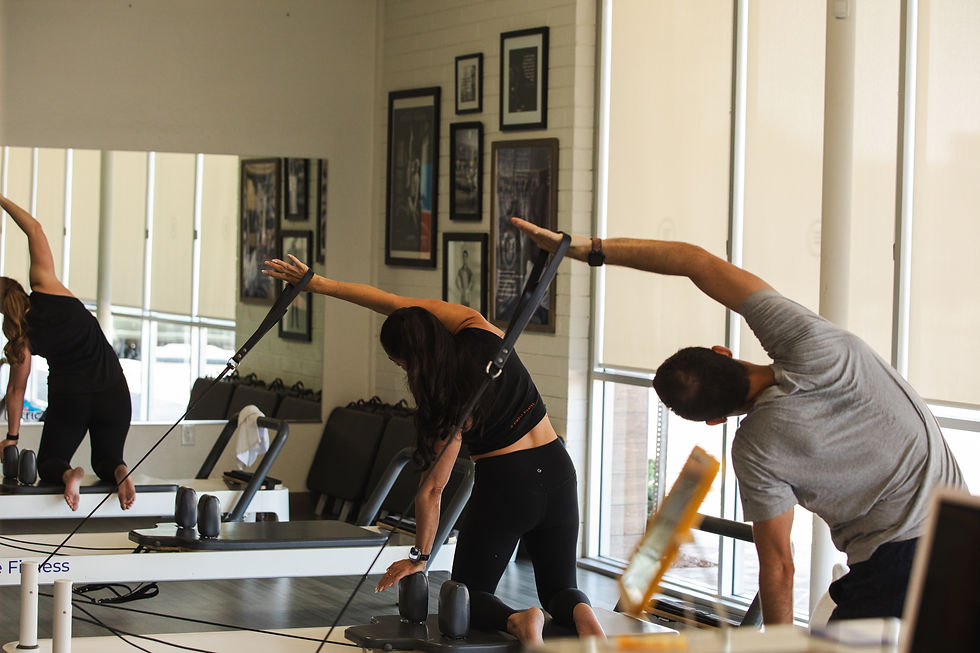
If you've never used one, I'll admit it can look a little intimidating. There are springs. Straps. A moving carriage. A footbar. It looks a little like exercise equipment and a little like something you might have found in a medieval dungeon.
But there's a reason the Reformer has been around for so long.
The springs create resistance while the moving carriage challenges your stability and control. Depending on the exercise, the Reformer can support your movement, challenge your movement—or somehow manage to do both at the same time. And that's part of what makes it such an incredible training tool.
Pilates Makes It Very Difficult to Cheat
This might be one of my favorite things about the Reformer.
Your body is smart. If one muscle isn't doing its job, another one will happily take over. Your hips shift. Your shoulders creep toward your ears. Your back arches. Suddenly you're technically doing the exercise...but not necessarily using the muscles the exercise was intended to train.
We call these compensation patterns, and everyone has them. The Reformer has a wonderful way of exposing them. Because the carriage moves, you have to stabilize while you're creating movement. You can't rely entirely on momentum.
You have to control the exercise.
And sometimes slowing something down makes it much harder than speeding it up.
Anyone who has ever had their legs shaking during a painfully slow Reformer exercise knows exactly what I'm talking about.

Your Core Is Doing More Than Crunches
Another reason I love Pilates is the way it trains the core.
When most people hear "core workout," they immediately think about abs.
Usually crunches. Maybe a plank if we're feeling ambitious.
But your core is a much bigger system responsible for stabilizing your spine and pelvis while your arms and legs move around it. That's incredibly important in real life.
Every time you pick something up, carry groceries, climb stairs, reach overhead, or twist to grab something behind you, your core is helping stabilize your body.
Pilates teaches those muscles to work together. Not because we're trying to create six-pack abs.
Because we're trying to create a body that works.
Why We Combine Pilates With Strength Training
This is where TriCore is a little different. I love Pilates. But I also believe people need to lift weights.
Especially as we age. We need muscle. We need bone strength. We need the ability to produce force.
Pilates is an incredible tool, but I don't believe it needs to exist in its own little fitness bubble.
That's why we combine it with functional strength training. Strength training teaches your body to produce force. Pilates teaches your body to control it. Put those two things together and something pretty great happens.
You become strong without losing mobility. You develop stability without becoming rigid. And you start understanding how your body moves instead of simply asking it to work harder.
Low Impact Doesn't Mean Easy
This is another misconception I'd like to retire. Low impact does not mean low intensity.
You don't have to jump, run, or beat up your joints to challenge your body.
A well-designed Reformer Pilates workout can be incredibly demanding.
The difference is that the challenge often comes from control, stability, precision, and time under tension rather than impact. It's a different kind of hard. And for a lot of people, it's exactly the kind of hard their body needs.
The Goal Is a Body That Works Together
At TriCore, we aren't interested in creating the strongest legs possible while ignoring everything else. We're interested in the whole system.
Can you create strength?
Can you control it?
Can your joints move through healthy ranges of motion?
Can your core stabilize you while you're doing it?
Can you still do all of those things ten, twenty, or thirty years from now?
That's why Reformer Pilates is such an important part of the TriCore Method.
It fills in the spaces traditional strength and cardio workouts often miss.
And when you combine them? That's where things get interesting.


Comments