
Your Workout Should Support Your Nervous System. Not Destroy It


Your Workout Should Support Your Nervous System. Not Destroy It
Somewhere along the way, the fitness industry decided exhaustion was proof of a good workout.
If you weren't dripping in sweat, crawling out the door, or unable to sit down comfortably the next day...Did you even work out?
For years, we celebrated phrases like "no pain, no gain" and "go hard or go home."
I have a different opinion, sometimes going home is exactly what your body needs.
Harder Isn't Always Better
Let me be clear, I like hard workouts.
We teach challenging workouts at TriCore. I believe in pushing yourself, getting uncomfortable, building endurance, and occasionally wondering why your trainer seems so cheerful while you're suffering. That's part of training. But there's a difference between challenging your body and constantly stressing your body. I think we've lost sight of that.
Your workout doesn't happen in a vacuum.
Maybe you slept terribly.
Maybe work is stressful.
Maybe you're taking care of kids, aging parents, or both.
Maybe you've been sitting at a desk for nine hours.
Maybe your hormones are changing.
Maybe life is just...a lot right now.
Your body doesn't separate "work stress" from "workout stress."
Stress is stress.
Your Nervous System Is Paying Attention
Your nervous system plays a huge role in how your body responds to exercise.
When you're constantly under stress, your body spends more time in that fight-or-flight state.
Then we sometimes take that already stressed body and think:
"You know what this needs? Sixty minutes of maximum intensity."
Probably not.
Exercise can absolutely help manage stress. But the type, intensity, and frequency matter.
Exercise can absolutely help manage stress. But the type, intensity, and frequency matter. Sometimes your body needs to sprint, sometimes it needs to lift something heavy. Sometimes it needs controlled movement, deep breathing, and mobility work.
The trick is learning the difference.
You Don't Have to Earn Your Rest
This is another idea I'd happily remove from fitness culture. Rest isn't a reward for working hard enough. Recovery is part of training.
Your body doesn't actually become stronger while you're lifting the weight.
The workout creates the stimulus. Your body adapts during recovery. That's where the magic happens. More isn't automatically better. Better is better.
This Is One Reason We Love Pilates
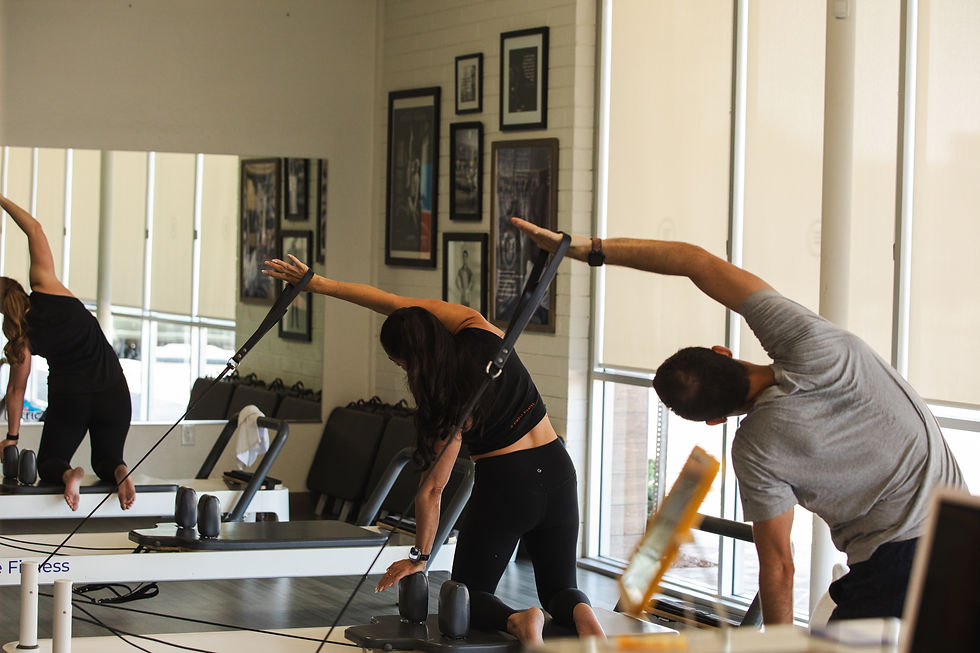
One of the things Pilates brings to the TriCore Method is intentional movement.
Breathing.
Control.
Concentration.
Mobility.
Instead of constantly asking the body to go faster, Pilates asks you to pay attention.
And you'd be surprised how difficult that can be. Moving slowly and intentionally gives you an opportunity to reconnect with your body instead of just powering through another workout.
That doesn't mean Pilates is always relaxing.
Anyone who has spent an uncomfortable amount of time holding a position on a Reformer can confirm that. But it's a different kind of challenge.
Listen to Your Body. Actually Listen
"Listen to your body" has become one of those fitness phrases people say all the time.
But I don't think we're always very good at doing it. Listening to your body doesn't mean never challenging yourself. It means knowing when to push and when to adjust.
Maybe today you lift heavier. Maybe tomorrow you decrease the weight. Maybe you take the modification. Maybe you walk. Maybe you stretch. Maybe you rest.
None of those choices mean you've failed your workout. That's training intelligently.
Sustainable Fitness Has to Leave Room for Life
If your fitness routine only works when you're sleeping eight hours, meal prepping every Sunday, drinking a gallon of water, and experiencing absolutely no stress...
Congratulations. You've designed a fitness program for a person who doesn't exist.
Real life is messy. Good training has to work inside of it.
That's why we believe in balancing endurance, strength, and mobility at TriCore.
Your body needs all three. It also needs recovery.
Sometimes it needs you to stop treating every workout like you're preparing for the Olympics. Unless, of course, you actually are.
You Should Feel Better Because You Exercise
This is really what it comes down to for me. Fitness should add something to your life.
More strength.
More energy.
More confidence.
Better mobility.
Less stress.
A body that allows you to keep doing the things you love.
Will you occasionally be sore?
Absolutely.
Will we occasionally ask you to do something you'd rather not do?
Also absolutely.
But the goal isn't to destroy your body.
The goal is to build one that supports you for a very long time.


Comments